bLAGI HOME

Regenerative Infrastructures

Regenerative Infrastructures

We are very pleased to announce the release of Regenerative Infrastructures, available now at Amazon and other retail outlets. This hardbound book, beautifully designed by Paul Schifino, is an in-depth exploration of the Land Art Generator Initiative for Freshkills Park on New York’s Staten Island. It is an excellent resource for everyone who is interested in the design of our renewable energy future.

In addition to showcasing details of 65 thought-provoking entries to the 2012 LAGI design competition, the book contains essays on art, urban ecology, and energy landscapes by writers such as Thaddeus Pawlowski (NYC City Planning, Urban Planning Dept.), Eloise Hirsh (Freshkills Parks Administrator, NYC Dept. of Parks & Recreation), Heather Rogers (Independent Journalist and contributor to New York Times Magazine, Mother Jones,and The Nation), Tafline Laylin (Independent Journalist and contributor to Inhabitat and Green Prophet), Mitchell Joachim (Terreform One), Ann Rosenthal (ecoartist and educator), Andreas Kipar (Landscape Architect), and Elizabeth Monoian and Robert Ferry (co-founders of LAGI).


Exhibition & Book Launch at Arsenal Gallery Central Park

Please join us on June 26 at Arsenal Gallery in Central Park. We will be celebrating the opening of the LAGI 2012 exhibit and launching the book. The exhibition will showcase the shortlisted proposals, and will be up until late August. There will be events in conjunction every two weeks, and we really look forward to seeing everyone and engaging in interesting conversations around energy and art. We’ll send another newsletter update in early June with more information and event dates.


Details from the Prestel Spring Catalog:

REGENERATIVE INFRASTRUCTURES: FRESHKILLS PARK NYC, LAND ART GENERATOR INITIATIVE

EDITED BY CAROLINE KLEIN AND LAGI, IN COOPERATION WITH NEW YORK CITY DEPARTMENT OF PARKS & RECREATION, THE INSTITUTE FOR URBAN DESIGN, AND THE COUNCIL ON THE ARTS & HUMANITIES FOR STATEN ISLAND

Formerly a symbol of immense urban waste, the Fresh Kills Landfill is being transformed into an enormous parkland that is destined to exemplify the values of ecological restoration and environmental sustainability. Part of that transformation includes a competition for a site-specific public artwork designed to operate as a source of clean energy for the city utility grid. This volume features many of the top submissions to the Land Art Generator Initiative, which aims to create sustainable design solutions that integrate art and technology into renewable energy infrastructure around the world.

The book draws a much-needed connection between the two critical issues of sustainable development—energy generation and waste management—highlighting solutions that address both problems at once, thereby creating economically beneficial hybrid utility installations.

CAROLINE KLEIN is an architect and freelance author and editor for international architectural magazines and publishing houses.

THE LAND ART GENERATOR INITIATIVE, founded in 2010 by Elizabeth Monoian and Robert Ferry, brings together artists, architects, scientists, landscape architects, and engineers to advance sustainable design solutions for large-scale renewable energy infrastructure.

240 pages with 250 illustrations; Hardcover; 11 x 9 in. / 28 x 23 cm; ISBN 978-3-7913-5286-2; Publication date: May 2013.


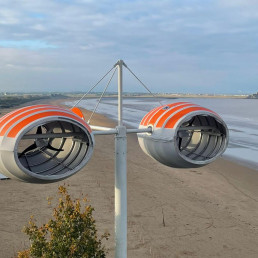
The School of Electrical Engineering, Mathematics and Computer Science at Delft University of Technology (TU Delft) has demonstrated a working prototype of an entirely new type of wind energy generator—the EWICON. What is so interesting is that this wind energy harnessing device works without any blades or moving parts.

This makes it much more easily integrated into buildings than conventional wind turbines, which cause vibration, noise, and shadow flicker. It also means that these new wind power generators may have longer useful life and require less maintenance.

The science behind it is less than intuitive.

The model-EWICON is quite abstract in appearance. A fluid steel frame in the shape of a rectangular zero surrounds a framework of horizontal steel tubes. Within the framework, charged droplets are formed, which are then blown away by the wind. The movement of the droplets produces electric power that can be transferred to the electricity grid. In 2009, Mecanoo used the EWICON in their design of the Stadstimmerhuis 010 building in Rotterdam, with two EWICONS being deployed to create the 010 symbol on the roof. The EWICON will be developed further if funding is secured for follow-up research.

But this video may help to explain it…

It reminds us a little of the principle at work in Kelvin’s Thunderstorm, but while in Kelvin’s model the charged particles are moved by gravity, in the EWICON, the particles are moved by the wind. There are also great similarities with Alvin Marks’ Vaneless Ion generator.

via Earth Techling


The latest edition of Landworks Sardinia will be taking place at Parco della Maddalena, Sardinia between May 23rd and June 2nd this year.

From the flyer:

the LANDWORKS no profit Cultural Association in collaboration with the Parco dell’Arcipelagolo di la Maddalena, the Assessorato all’Ambiente della Regione Sardegna, the Agenzia del Demanio della Sardegna, the Comune di La Maddalena and other partners, will realize a number of on-site projects to underline the significance of the landscape, the natural and cultural heritage of Caprera Island.


Thanks again to thejamjar Dubai for hosting the exhibit last month! Below is the information graphic that was on display during the show. Click on any of the images to download the PDF file.

Solar Vortex

We learned of yet another “twist” on solar power generation via this Forbes article about the ARPA-E conference in Washington D.C.

The Solar Vortex borrows its inspiration from dust devils, those miniature twisters of excited dirt that sometimes arise in the dusty and dry stretches of the U.S. Southwest. What gets a dust devil going is the difference in temperature between the scorching-hot ground and the somewhat cooler air above. The hot air rises, twists and gives rise to a momentary dust tornado.

Georgia Tech is the leader of a consortium that aims to capture this dust-devil energy inside a stubby cylinder. The concept is simple: The cylinder sits upon a dark surface that absorbs lots of heat. The “walls,” so to speak, are angled vanes that take the hot air rising off that hot surface and twist it into a vortex. At the top, a set of fan blades sit in the path of the rising air. The fan blades turn, activating a generator that creates electricity.

The video below is a miniature model of the Solar Vortex on the exhibition floor. The cylinder sits on a plate that is, like hot pavement, almost too hot to touch, about 47 degrees Celsius (116 degrees Fahrenheit). The movement you see in the blade is solely from the force of moving air.

More from the Forbes article:

Georgia Tech has already purchased gotten rights to use a site in Mesa, Arizona — plenty of heat there — and is working toward building a 50-kilowatt commercial-scale model. Final negotiations with ARPA-E are underway for an intermediate step: a 10-kilowatt version by 2015. Arne Pearlstein, a professor of mechanical engineering who is a collaborator, told me that the commercial-scale version might be 10 meters wide but only two or three meters tall, and that the units would sit about 55 meters apart. These squat machines could bring renewable energy to regions that are bombarded by heat but don’t have much wind. (Though gusts of wind would only serve to make the turbine spin faster, Pearlstein said.)

Pearlstein estimated that the Solar Vortex could spin out electricity 20 percent cheaper than wind turbines and 65 percent cheaper than solar photovoltaic panels. One form of saving comes from its potentially straightforward maintenance. “You’re talking about somebody getting up on a stepladder instead of going hundreds of meters up into a wind turbine to deal with a gearbox,” Pearlstein said.

It seems that this idea could have a lot of potential for conceptually inspired applications that would make a larger Solar Vortex installation a real destination art piece.

More information on the Georgia Tech research can be found here (more diagrams and videos). In searching for more information on the idea, we came across a number of similar concepts and pending patents. More examples of supporters of the technology can be found here and here.

Yesterday evening we moderated an open discussion on the aesthetic integration of sustainability systems into the built environment. Thanks to all who came out and contributed your thoughts; it was an inspiring conversation!

Thanks especially to Emanuele Mattutini, founder of LEAP Architecture, who generously took us through his design process, which is informed by a keen awareness of natural energies and passive strategies.

And thanks to thejamjar Dubai for organizing the evening and to The Archive: Safa Park for hosting us all. What a great space!

FutureEnergy

Thanks to everyone who came out on Monday for the opening of The Future of Energy Looks Good at thejamjar Dubai. And thanks to the artist teams whose work is represented in the show. Here are just a few pictures from that night.

Everyone was very engaged with the work, taking the time to ask questions about the concepts and technologies, and reading the full descriptive texts from the binders on the podiums.

FutureEnergy

FutureEnergy

FutureEnergy

FutureEnergy

FutureEnergy

FutureEnergy

FutureEnergy

FutureEnergy

FutureEnergy

FutureEnergy

FutureEnergy

FutureEnergy

FutureEnergy

We’re honored to have been included in the esteemed group of inhabitat.com 2013 eco-prognosticators.

Here are our predictions that you’ll find cross-posted there:

With the consequences of 2012′s severe weather events fresh in our collective memory, and yet having survived the momentous transition to the next Mayan b’ak’tun, we will begin 2013 with renewed focus on the real climate change threat to the stability of our planet. Designers will respond ever more directly to the challenges (opportunities) of the fossil fuel divestment and environmental justice movements, and show the world that it is possible to keep 4/5 of our proven reserves in the ground and further decouple GDP from fossil fuel consumption.

The expansion of the WindMade™ eco-label into other renewables will help to bring about a universal consumer awareness movement, making low-carbon retail goods as ubiquitous as certified organic foods. Cradle to Cradle® and similar certifications will make serious inroads into consumer goods at big box stores (such as pet products and kids’ toys), and integrated solar chargers will appear on many more items that would otherwise rely on disposable batteries.

Contemporary design manifestations on pre-industrial (low-energy) ideas will surface. For example, features like root cellars (a natural progression of the local food movement), yakhchal (ancient passive cooling system), and winter gardens (fresh food year-round) may become more prevalent in sleek new residential architecture.

Concentrated photovoltaic multijunction cells will leap past the 50% threshold of efficiency in the lab, and low carbon organic thin films will see groundbreaking efficiency gains and production cost savings, bringing the price per installed watt and payback periods down to levels that will create an historic tipping point.

Based on our experience this past year with LAGI 2012, we can safely predict that university art and design programs will more and more utilize interdisciplinary curricula that combine design with low-carbon engineering innovation.

Crowd-source funding and amortized purchase of renewable energy will continue to grow and we will see an outbreak of renewable energy cooperatives springing up to power neighborhoods. New innovative design solutions will emerge for the aesthetic integration of renewable energy infrastructure into the city and agricultural landscape.

In general, we are very optimistic about the trends for green design. We are encouraged every day by our interactions with innovative designers who are thinking holistically about permaculture and living solutions that can continue to raise our standard of living smartly and in harmony with our natural environment.

Please join us on Monday, January 14, 2013 for the opening of an exhibit at thejamjar in Dubai. Twenty-five of the design proposals from the 2012 Land Art Generator Initiative for Freshkills Park, NYC will be on display, along with four of the 2010 proposals for the United Arab Emirates and some educational information about renewable energy and the UAE.

We’ll also be holding workshops and a panel discussion over the duration of the exhibit. The events that are open to the public are as follows:

Workshop
January 19
10am – 4pm

Panel Discussion
January 23
7pm – 9pm

More details are coming soon. Sign up for our mailing list (the red circle up top) to keep up to date. Hope to see you there!

Support for these events comes from the National Endowment for the Arts.

Please Donate

Please click the image to donate. Thank you!

We believe that the way to nurture a creative process is to make it fully accessible to all, and we have therefore not charged an entry fee for the LAGI design competitions. It’s possible that the one person who is excluded from participation in a competition because they were unable to pay might just be the person who has an idea that could change the world…

Today we are kindly asking those of you who can to help us with a modest donation so that we may meet our current fiscal shortfall and cover the publishing costs of the LAGI 2012 book. We are a very small non-profit and 100% of our time is volunteer. We’ve dedicated ourselves to the LAGI project over the past four years because we believe in the power of art and design to drive positive change, and we see that LAGI is successfully bringing creative and concerned people together to envision a beautiful and sustainable renewable energy future.

Please help us today by going to our current fundraising campaign or by donating directly to Society for Cultural Exchange.

If everyone reading this gave just a few dollars to our indiegogo campaign we would meet our goal!

Your donation is tax-deductible and while we welcome gifts in any amount (even a dollar!), we hope that the perks we are offering in the image on the right will let you know how much we appreciate your kind generosity. If you are unable to contribute, please share this email with someone who can.

The design of our constructed environment is of critical importance to the health of our cities. Beautiful cities attract greater investment and increase livability. This fact is of great importance to solar and wind power generation projects that are sited near the places where we live and recreate.

The Land Art Generator Initiative (LAGI) is presenting the world with new and inspiring design solutions for renewable energy power plants. Through a biennial design competition, we’re bringing together teams of artists, architects, engineers, landscape architects, designers, and scientists to conceive of large-scale works of public art that have the added capability of generating renewable power at a utility scale.

LAGI has received more than 400 design proposals from design teams representing more than 50 countries, and has helped contribute to an expanded interdisciplinary education for hundreds of students.

We are happy to announce that in May 2013, the book Regenerative Infrastructures will be available. In addition to showcasing details of 65 thought-provoking entries to the 2012 LAGI design competition, the book will also contain essays on design, art, architecture, waste, and energy.

A book launch and expanded exhibit will be taking place at Arsenal Gallery in NYC’s Central Park in the summer of 2013.

« Older entries