bLAGI HOME · infographics

infographics

You are currently browsing articles tagged infographics.

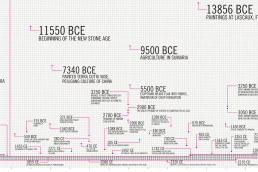
click on the image above to explore make sure you zoom in deep to see the detail

The piece is meant to provide a context for the age of fossil fuels and question our ability to adapt to a post-fossil fuel age that is rapidly approaching. It’s the second in a deep zoom series exploring the time context of our access to carbon energy. The previous version is a longer view and can be seen here.

A similar PDF version is available as a PDF download in the sidebar of this blog.

Tags: , ,

The image above will take you to a high resolution graphic that spans 800,000 years. Each year is represented by one small square. Each row equals one millenium.

Time flows from the upper left to the lower right (similarly to how you are reading this text). Have fun exploring the details by zooming in and panning around. the lower right hand corner button will take you to a full screen version.

The piece is meant to provide a context for the age of fossil fuels, to illustrate the great advancements that their consumption has brought us, and to question our ability to move beyond them in a post-fossil fuel age that is rapidly approaching.

This is an expanded version of the smaller 25,000 year graphic that is available as a PDF download in the sidebar of this blog.

Tags: , , , , ,

SolarVSCoal
click on the image for a larger version.

Mountaintop removal mining (MTR) is a form of surface mining that involves the removal of a summit or ridge. Acres of wilderness habitat is deforested and the wood burned. Explosives are then used to blast away the overburden (soil and rock) to expose the coal seams that lie beneath. An average of 3 million pounds of explosives are detonated in West Virginia every day.

More than 500 mountaintops have been destroyed so far. The air pollution from surface mining activities has led to elevated levels of adult hospitalizations for chronic pulmonary disorders and hypertension; higher rates of mortality; lung cancer; and chronic heart, lung, and kidney disease for individuals living in mining areas.
In addition, 2,000 miles of Appalachian streams have been buried by mining refuse. Valley fill (VF) destroys natural habitats and pollutes watersheds with high levels of selenium and other toxic compounds.

The small blue square (516 square kilometers) on the above map represents the surface area of mountaintop that has been removed in southern West Virginia as of 2010. The same area is also represented on the map in the exact locations of the MTR mining sites.

The small yellow square (312 square kilometers) represents the land surface area that would be required to generate 124.8 terrawatt-hours of electricity each year. This is the same amount of electrical power that is generated by the 63.4 million short tons of coal that is mined from the exploded tops of West Virginia mountains each year.

This large blue square represents 1.4 million acres of Appalachian forest that has been disturbed or cleared as a consequence of mountaintop removal mining practices according to the Environmental Protection Agency.

This larger yellow square represents the land surface area that would be required to generate 1,850 terrawatt-hours of electricity each year. This is the total amount of electrical power that is generated by the more than one billion short tons of coal that is burned in the United States each year in coal-fired electrical power plants. MTR coal amounts to less than 5% of the total US coal production.

The side effect of all this coal combustion for electrical power is that 2.8 billion tons of carbon dioxide, 7.6 million tons of nitrogen oxide, and 7.5 million tons of sulfur dioxide are dumped into the earth’s atmosphere each year, along with other harmful gases and chemicals.

The solar panel installations that would be required to replace all West Virginia MTR coal would cost approximately $180 billion to construct.

If West Virginia decided to produce the panels in-state, it would provide more than 10,000 new jobs—about the same number that have been lost since 1990 in the US mining sector (MTR techniques extract 2.5 times the amount of coal per worker as compared with mining techniques that are more sensitive to the environment).


Mud River, West Virgina. (Graphic from www.ilovemountains.org)

More information can be found at:

http://ilovemountains.org/
http://earth.google.com/outreach/cs_app_voices.html
http://www.seesouthernforests.org/news/mountaintop-removal-cuts-through-southern-forests
http://www.eia.gov/cneaf/coal/weekly/weekly_html/wcpweek.html
http://www.eia.gov/coal/data.cfm, http://www.eia.gov/cneaf/coal/quarterly/html/t1p01p1.xls
http://www.blm.gov/ut/st/en/prog/energy/coal/electricity_conversion.html
http://earthobservatory.nasa.gov/Features/MountaintopRemoval/
http://www.epa.gov/region3/mtntop/eis2005.htm

Tags: , ,